Background
TD3D's color-measurement work depends on trusting the instrument and the process that feeds it, not just the numbers that come out. Our first published validation run established that a burn-and-scan session needs enough readings, in the right places, to produce a trustworthy result — a single reading per cell isn't enough.
This lab is the next run in that validation effort. Before this burn, an earlier design pass identified a data-handling issue in how the test layout was being assembled — a step that could otherwise cause cells to be mislabeled or fired with the wrong recipe — and corrected it. This run was the first chance to confirm that fix on a real burn, using a dedicated 12-cell validation coupon rather than reusing an earlier one.
Objective
Validate the measurement chain end to end: confirm the corrected layout-assembly process preserves an authored design through to the physical burn, and confirm the Nix Spectro 2 produces a repeatable, trustworthy reading under our multi-scan protocol. This was a measurement-validation run, not a color-family or finish study.
Experimental design
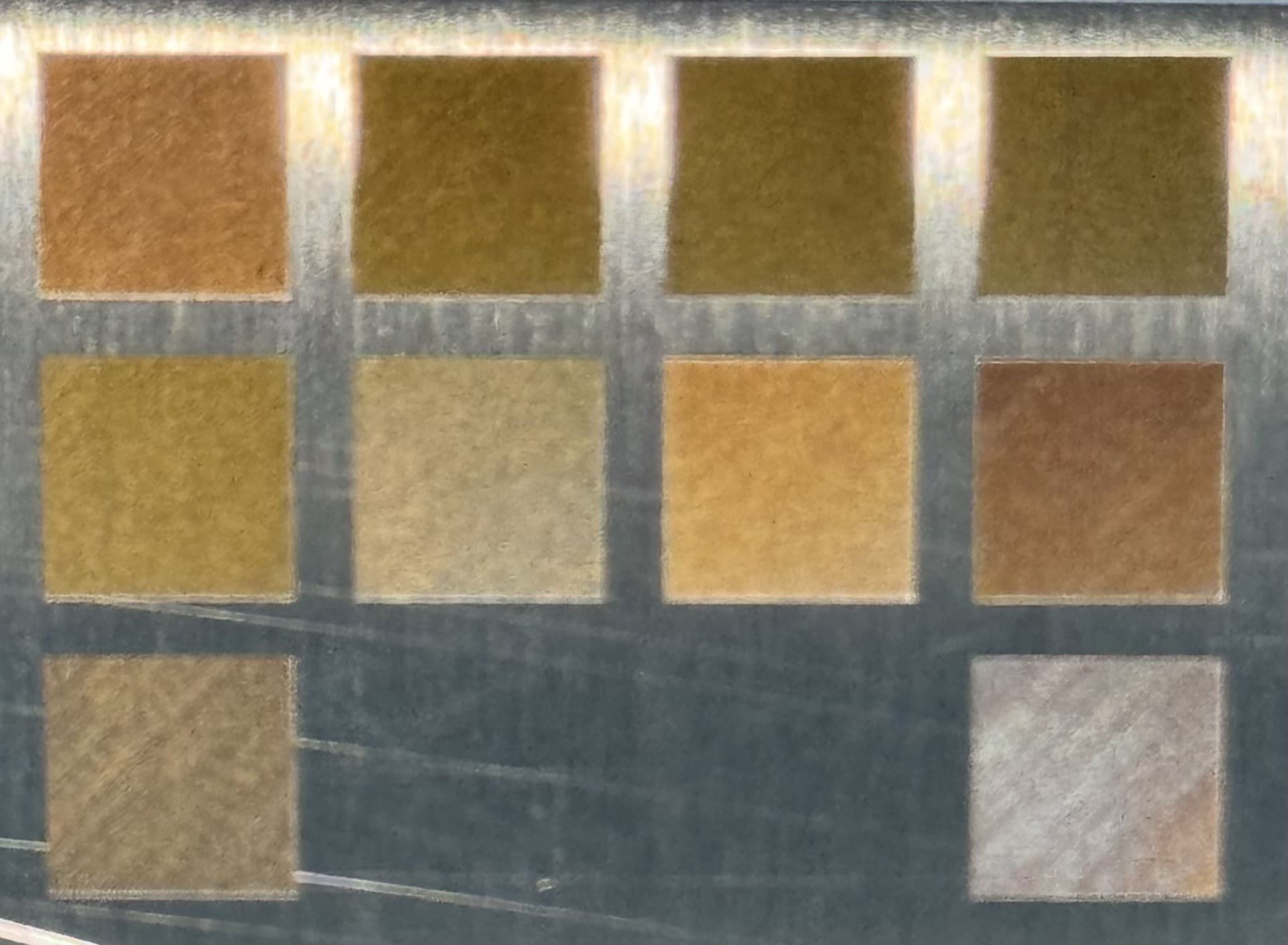
The validation coupon carried 12 cells across five roles:
- 5 CONTROL cells (K01–K04, QC-1), all burned at one identical recipe, meant to establish a shared color baseline
- 3 TEST cells (V1–V3), one per speed (350, 250, and 150 mm/s), included to exercise the instrument across a range of tones
- 2 BLANK cells, left deliberately unburned as a bare-substrate reference
- 1 LOCATOR cell, used only for physical orientation on the plate
- 1 SACRIFICIAL cell, burned first to neutralize any startup effects before the cells that matter were burned
QC-1, one of the five control cells, also served as the dedicated repeatability host: 10 static reads without moving the instrument, plus 5 additional reads lifting and re-seating it between each one.
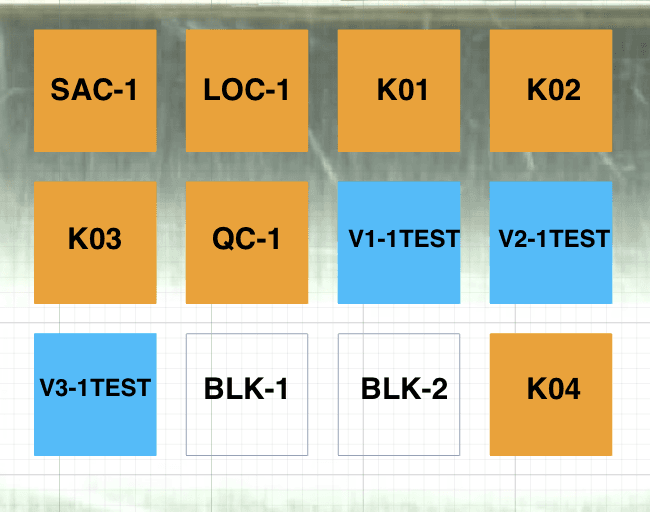 Figure 2. LAB-0004 cell layout, labeled by role. Burn order runs left to right, top to bottom.
Methodology
The coupon — a 304 stainless steel plate, mirror finish — was burned in a single session, approved and confirmed by a human operator; nothing fired automatically. Before burning, the laser's aperture-to-cell fit and the spectrophotometer's self-calibration were both checked and logged. After burning, the coupon was photographed and scanned with the Nix Spectro 2: 55 total readings across all measured cells, all in D50/2°/M2 geometry, hash-verified and logged alongside the photo evidence. The full run — design, burn approval, burn confirmation, evidence ingest, and audit — took about 15 hours.
Every reading was checked against the same multi-scan validation protocol established in our first run: a minimum number of reads per cell, a static-repeatability check, a re-seat repeatability check, and agreement across the identical-recipe control cells tight enough to set a shared measurement tolerance.
Results
The corrected layout-assembly process held up: the authored design — which cell plays which role, which recipe each one uses, which cells stay blank — matched what was actually burned, with no mislabeling.
The instrument performed very well. Static repeatability (10 reads on one cell, without moving it) averaged ΔE00 0.118, with a maximum of 0.179. Re-seat repeatability (5 reads, lifting and re-seating the instrument each time) averaged 0.138, with a pairwise maximum of 0.367. Both are well inside the thresholds we require before trusting a reading. The three test cells also each showed at least one internally consistent reading area, meeting our within-cell consistency check.
Where this run did not pass: the five identical-recipe control cells did not agree with each other. Their measured colors ranged from ΔE00 1.13 (the closest pair) up to ΔE00 11.41 (the widest pair) — well outside the ≤2.0 agreement threshold this check requires. Because the instrument itself measured so consistently elsewhere in this same run, this spread does not look like instrument noise. Lightness (L*) fell steadily in the same order the cells were burned in — 17.980, 17.870, 15.023, 11.412, 7.085 — rather than scattering randomly. The two blank (unburned) reference cells agreed closely with each other, as expected.
Discussion
The evidence here is consistent with accumulated heat across the burn sequence affecting the resulting color — later-burned cells measured progressively darker, in a smooth, one-directional pattern rather than random scatter. That's the leading hypothesis, but this design cannot fully separate "burned later in time" from "positioned differently on the plate," since the control cells weren't repeated at different points in the sequence. Further experimentation — repeating identical-recipe controls at the start, middle, and end of a burn sequence — is needed to isolate the effect before it can be treated as established.
What this run does establish cleanly: the measurement instrument and protocol are sound, and the layout-assembly fix from the previous design pass held under a real burn. The open question this lab surfaces — whether, and how much, burn sequence affects color at a fixed recipe — is now a well-defined, measurable question for the next run, rather than an unknown.