Background
Our previous validation run found something unexpected: five cells burned at one identical recipe measured wildly different colors, spanning ΔE00 11.41 — far more than instrument noise could explain. The leading idea at the time was that heat builds up across a burn sequence, and later-burned cells come out darker.
This lab was designed to test that idea directly, by comparing two ways of running the same recipe: burning cells back-to-back with no pause, versus adding a pause between each burn to let the coupon cool.
Objective
Test whether pausing between burns (dwell) reduces color drift among identical-recipe cells, and — if it does — characterize the effect. Frequency was held fixed throughout, so this lab does not touch open questions about frequency or delivered power.
Experimental design
Two coupons carried 16 cells each (32 total), split into two arms:
- ACCUMULATION arm (one coupon): 12 identical-recipe control cells burned back-to-back, with no deliberate pause between them.
- ISOLATION arm (the other coupon): 12 identical-recipe control cells burned with a logged pause between each one.
Each coupon also carried 2 bare, unburned reference cells, 1 orientation fiducial, and 1 burned-first cell to absorb any startup effects before the cells that matter were burned.
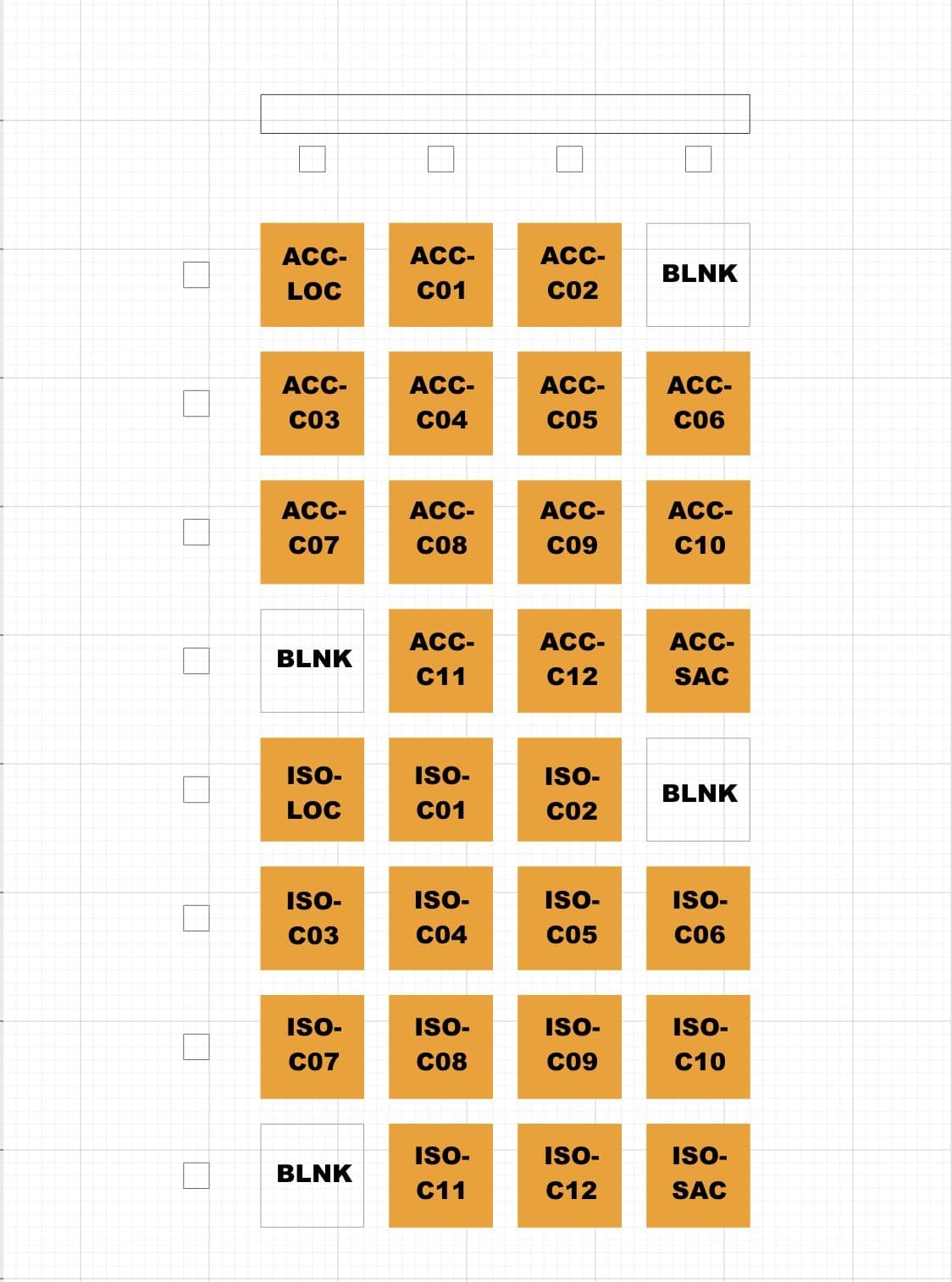 Figure 2. LAB-0005 layout reference, showing the ACCUMULATION and ISOLATION arms across both coupons.
Methodology
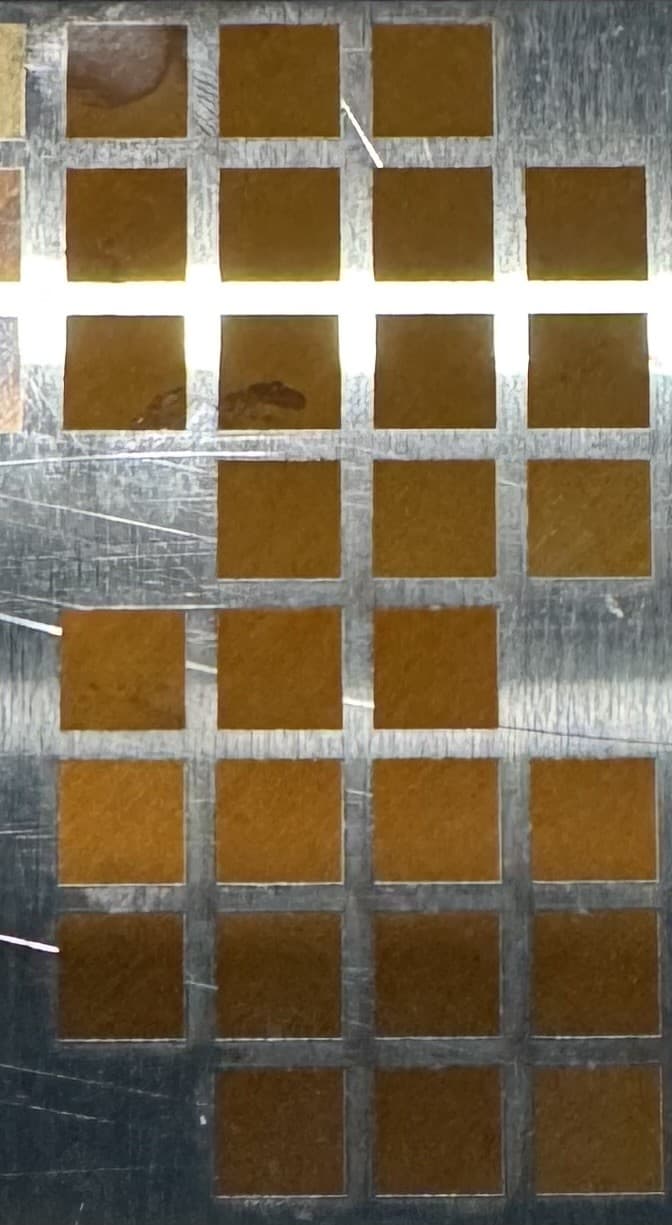
Both coupons — 304 stainless steel, mirror finish — were burned in a single manual, cell-by-cell session; nothing fired automatically, and every burn was timestamped as it happened. After burning, both coupons were photographed and scanned with the Nix Spectro 2: 132 total readings, all in D50/2°/M2 geometry, hash-verified and logged alongside the photo evidence.
Every reading was checked against the same measurement-validation protocol used in our earlier runs, and the authored cell layout was checked against what was actually burned, and the actual firing order was checked against what was planned.
Results
Execution matched the design exactly: all 32 cells matched their authored role, and all 28 burnable cells were captured with an actual firing order, timestamp, and logged pause.
The instrument performed very well in both arms. Within-cell repeatability averaged ΔE00 0.77 (worst 1.48) in the back-to-back arm and 0.58 (worst 1.03) in the paused arm — both comfortably inside the thresholds we require. Bare, unburned reference cells in both coupons read as bright specular metal (L* roughly 79–82), consistent with our earlier runs.
Where the two arms differed: the paused arm's identical-recipe controls agreed with each other more closely (max pairwise ΔE00 3.14) than the back-to-back arm's did (4.39), and this held at every stage of the firing order, not just overall. Control lightness (L*) drifted mildly in both arms as firing order progressed — but in the lightening direction (+0.16 to +0.20 L* per step), the opposite of the darkening trend found previously.
Critically, neither arm reproduced the drift this lab was built to explain. The prior run's identical-recipe controls spanned ΔE00 11.41; here, both arms topped out under 4.4, and the whole burned-color range sat roughly 20 L* units lighter than before.
Discussion
The paused arm's lower drift is consistent with dwell playing some role, but this result cannot be treated as evidence that the pause caused it. Each arm was burned on a different physical coupon, and the two coupons were not equally uniform to begin with — their own unburned reference cells disagreed with each other by more than the two arms disagreed with each other. A more uniform piece of steel and a genuine dwell effect would look the same in this data, and this design cannot tell them apart.
There is also an open question about the pause itself: the paused arm's cells were logged with a fixed 60-second pause, but the actual timestamps between burns imply a real pause closer to 17 seconds. That gap is large enough that the "60-second" label should be treated cautiously rather than as a precise measured quantity.
Most importantly, the color drift this lab set out to decompose simply wasn't present at the same magnitude here. Further experimentation — starting with a straightforward repeat of the original identical-recipe sequence on one coupon — is needed before any cause, dwell or otherwise, can be meaningfully isolated.