Background
Our previous validation run found that five cells burned at one identical recipe did not agree with each other — a spread far outside our measurement-agreement threshold, with lightness falling in the same order the cells were fired. A follow-up dwell-pause run tried to isolate that effect but couldn't reproduce the original drift at all, leaving the question open: is identical-recipe color drift a real, repeatable phenomenon, and if so, what actually drives it?
This lab set out to reproduce that original finding directly, on a fresh coupon, with a layout designed to tell burn order and physical position apart — something the earlier runs couldn't do on their own.
Objective
Reproduce or refute the color non-uniformity observed in identical-recipe control cells, using the same fixed recipe as the original run, on a single fresh coupon laid out so that firing sequence and grid position are not confounded with each other.
Experimental design
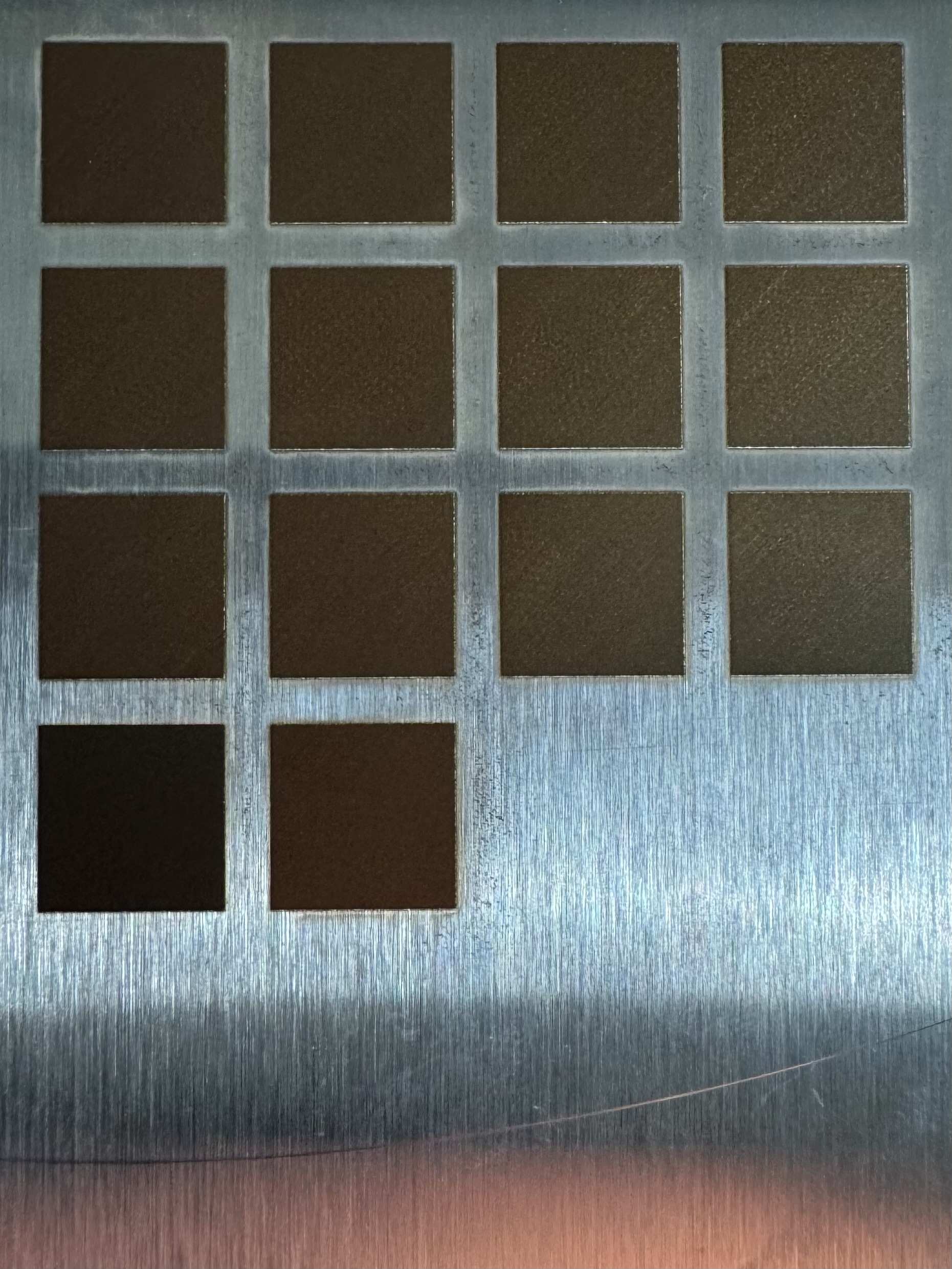
The coupon carried 16 cells: 12 CONTROL cells filling a 3-column-by-4-row block, all burned at one fixed recipe, plus 1 SACRIFICIAL cell (burned first, to neutralize any startup effects), 1 LOCATOR cell (physical orientation only), and 2 BLANK cells left unburned as a bare-substrate reference.
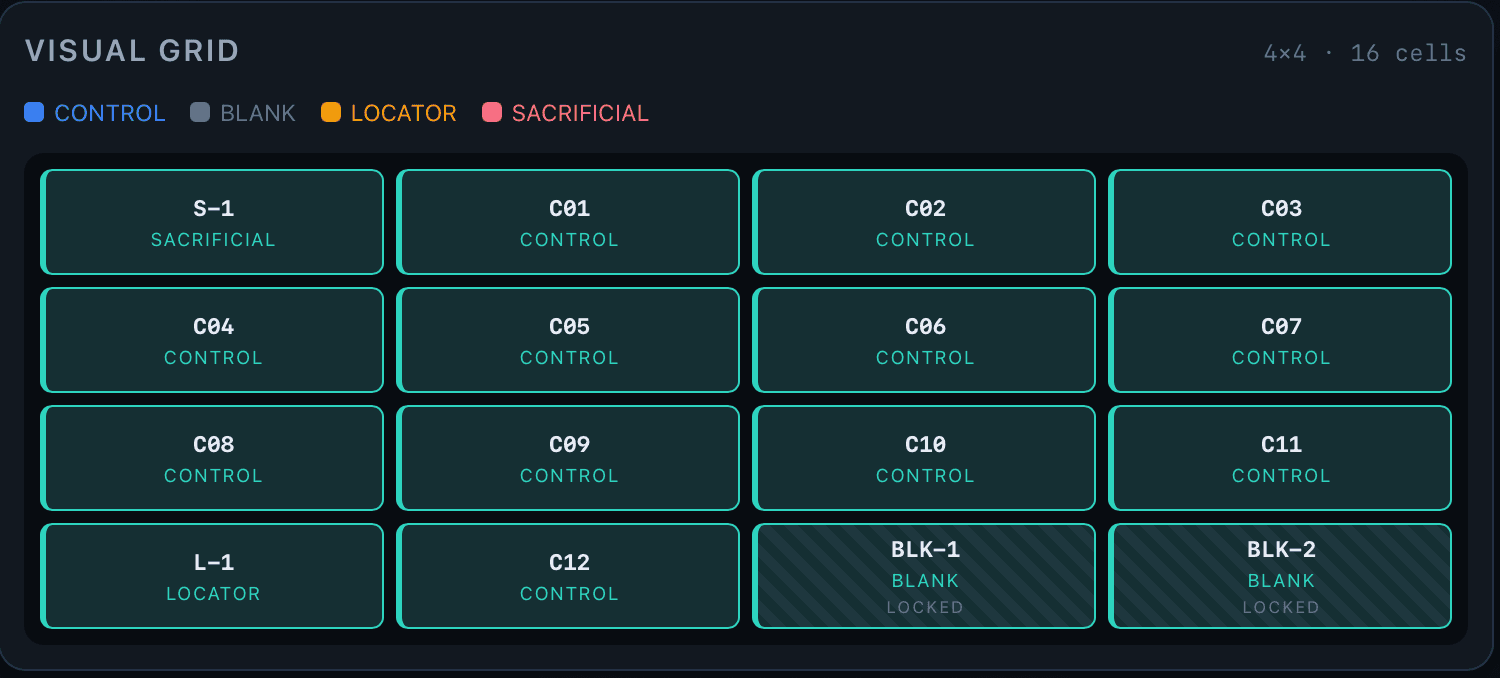 Figure 2. LAB-0006 experimental layout showing the control-cell positions and firing sequence used to compare spatial and burn-order effects.
Methodology
The coupon — 304 stainless steel — was burned in a single session, approved and confirmed by a human operator. Cells were fired row-major, left to right, top to bottom. After burning, the coupon was photographed and scanned with a Nix Spectro 2 spectrophotometer in D50/2°/M2 geometry: 71 total readings across all cells (5 reads per control cell, 3 per blank), hash-verified and logged alongside the photo evidence.
Each control cell's measured lightness (L*) was correlated separately against its firing order and against its column position on the grid, to see which one better explained the observed spread.
Results
The control cells did not agree with each other. Measured lightness spanned L* 30.66 to 35.49 (ΔL* 4.84), and the two most different cells measured ΔE00 4.94 against our 2.0 agreement ceiling. This spread was well outside instrument noise: typical within-cell repeatability was about 0.28 L* (worst case 0.49) — the cell-to-cell spread was roughly 17 times larger.
Firing order correlated only weakly with measured lightness (r = -0.37, R² = 0.13), and the relationship didn't hold up cell by cell — some later-fired cells measured lighter than earlier ones, which a simple accumulating-heat story doesn't explain.
Column position across the coupon correlated far more strongly (r = -0.95, R² = 0.90), with lightness declining in a consistent slope of about -1.27 L* per column moving across the field. There was no comparable pattern from top to bottom (r = -0.09). Color values (a*, b*) moved together with lightness along the same gradient, staying within one dark bronze/brown family throughout — this was a brightness effect, not a change in hue. The unburned blank cells measured around 77.9 L*, confirming the underlying substrate was itself consistent.
Discussion
The original color non-uniformity reproduces: this is a real, repeatable effect, not measurement noise or a one-off result. What changed is the explanation. Burn order was not supported as the dominant driver in this run — the correlation was weak, and specific cells contradicted a simple accumulating-heat story. Instead, the data are consistent with a spatial gradient running across the coupon, with position explaining most of the measured variation.
A spatial gradient like this is the signature of something acting differently across the field — a coupon that isn't perfectly flat or evenly focused, or a machine-side effect in how the laser's scan field behaves at different positions. This run can't distinguish between those two possibilities: both would produce the same kind of position-linked pattern. The leading explanation is a physical, position-linked effect rather than a temporal, order-linked one — but the exact mechanism, and whether it belongs to the coupon or the machine, remains unresolved and is the natural next question.