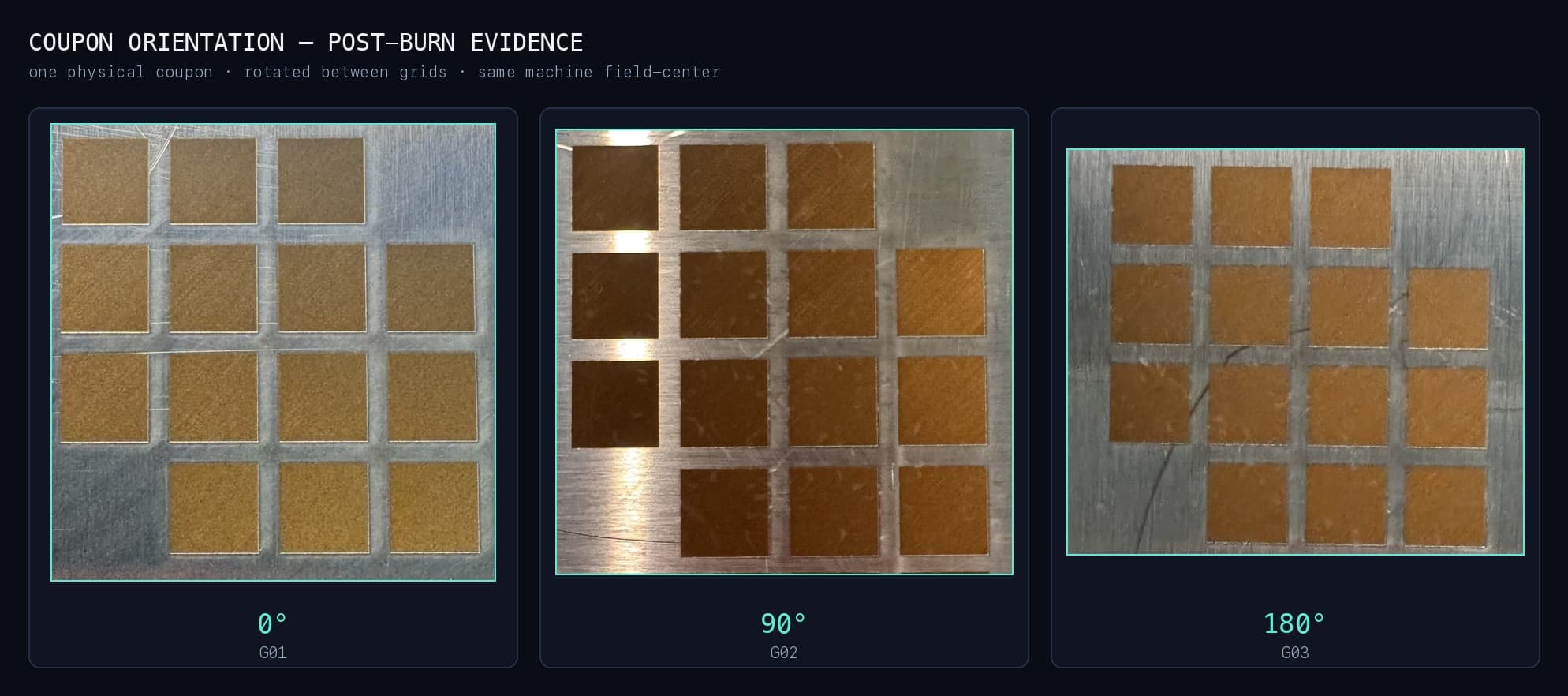
Background
Three rotated grids preserved a similar gradient direction in the machine frame, while the effect was substantially weaker than in LAB-0006.
Our previous reproduction run found a strong, repeatable spatial gradient across an identical-recipe control grid — measured lightness fell steadily across the coupon by column position — but that design couldn't tell whether the cause was fixed to the physical coupon (tilt, focus, or material variation) or fixed to the laser's own machine frame (scan-field behavior). LAB-0007 was designed as the direct follow-up: burn the same style of grid on one physical coupon three times, physically rotating the coupon 0°/90°/180° between passes while keeping every pass centered at the same machine field-center.
Objective
Determine whether the LAB-0006 spatial gradient rotates with the physical coupon (coupon-bound) or stays fixed to the machine's own frame of reference (machine-frame-bound), by burning the same fixed recipe on one coupon at three physical orientations and comparing the gradient direction measured in each.
Experimental design
One 304 stainless steel coupon carried three separate 4×4 grids (G01, G02, G03), each burned at the same fixed recipe and centered at the identical machine field-center. Between grids, the coupon was physically rotated onto a fresh, unburned region — 0° for G01, 90° for G02, 180° for G03. Each grid held 12 CONTROL cells (the measured gradient cells), 2 BLANK cells (bare-substrate reference), 1 LOCATOR cell (orientation reference), and 1 SACRIFICIAL cell (fired first to absorb any startup effect) — 16 cells per grid, 48 across the coupon, of which 42 were measurable.
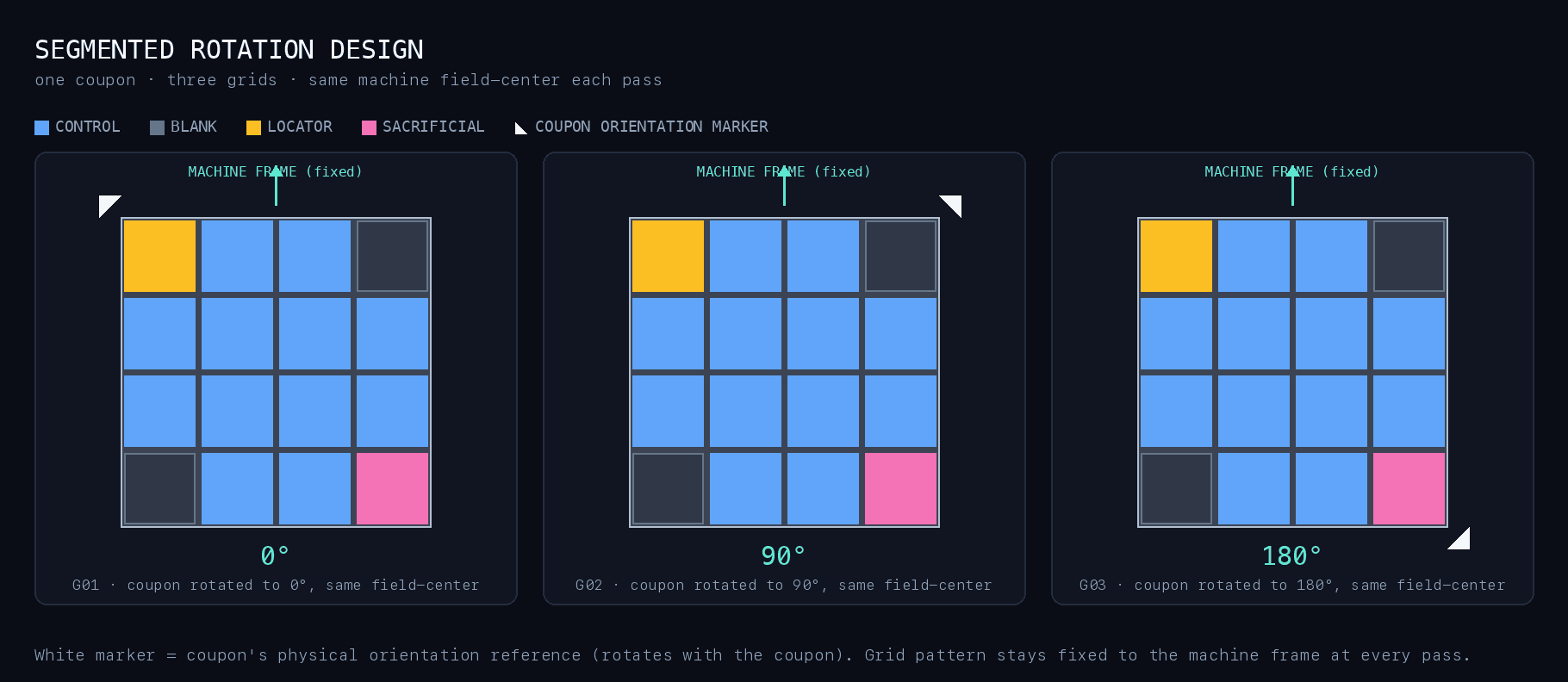 Figure 2. LAB-0007 segmented rotation design. Three grids were processed on one coupon at 0°, 90°, and 180° while retaining a common machine-frame reference.
Methodology
The coupon was burned in three physical passes, approved and confirmed by a human operator, using the same fixed recipe in every pass (see At a Glance) — only the coupon's physical orientation changed between passes. After burning, the coupon was photographed at each orientation, then scanned with a Nix Spectro 2 spectrophotometer in D50/2°/M2 geometry: 198 total readings across the three grids (66 reads per grid; 5 reads per CONTROL cell, 3 per BLANK cell), hash-verified and logged alongside the photo evidence. Each grid's measured lightness (L*) was analyzed as a gradient vector across its own row/column layout, and the resulting gradient direction and strength were compared across the three orientations.
Results
Measurement repeatability was excellent: CONTROL cells averaged a within-cell L* standard deviation of 0.182 (worst case 0.333), with a mean maximum ΔE00-to-centroid of 0.353 (worst case 0.668) — well inside our internal repeatability threshold. BLANK cells were noisier, as expected for specular bare steel (L* standard deviation 1.572, maximum ΔE00 2.510).
The six BLANK cells averaged L* 80.06 across all three grids, with a range of 2.51 — essentially uniform, with no positional or per-grid trend that could imitate an orientation effect.
- G01 (0°) — mean L* 34.16; column slope −0.192 (r = −0.775), row slope −0.098 (r = −0.396); gradient magnitude 0.216; direction 207.1°; R² 0.758.
- G02 (90°) — mean L* 35.63; column slope −0.275 (r = −0.873), row slope +0.025 (r = +0.081); gradient magnitude 0.276; direction 174.7°; R² 0.769.
- G03 (180°) — mean L* 34.20; column slope −0.124 (r = −0.685), row slope −0.051 (r = −0.284); gradient magnitude 0.134; direction 202.5°; R² 0.550.
Measured against G01, the gradient direction shifted by −32.4° at G02 and −4.6° at G03 — both far short of the +90°/+180° shift a coupon-bound gradient would be expected to produce, clustering within roughly ±30° of each other instead. The gradient magnitude across all three grids (about 0.13–0.28 L* per step) was roughly 5–10 times weaker than the approximately 1.27 L* per column measured in LAB-0006.
Discussion
The gradient's direction did not track the coupon's rotation. If the LAB-0006 gradient were fixed to the physical coupon, rotating it 90° and 180° should have rotated the measured direction by a similar amount; instead, the direction stayed within about ±30° across all three passes. That result is more consistent with a machine-frame-bound effect than a coupon-bound one, and it weakens a simple coupon-fixed explanation for the original LAB-0006 signature.
At the same time, this result does not pin down what specifically drives the effect. Several machine-side factors — galvo-field position, scan-direction behavior, and physical mounting or leveling — remain confounded with each other, and nothing in this design isolates one from another. The 180° grid also produced the weakest fit of the three (R² 0.55, versus 0.76–0.77 for the other two), and the measured gradient magnitude was substantially weaker than LAB-0006's, so the original effect's strength did not reproduce even though its direction pattern did. With only one grid burned per orientation, on a single coupon, this should be read as evidence pointing toward a machine-frame effect rather than a resolved mechanism — replication is required before the conclusion can be strengthened.